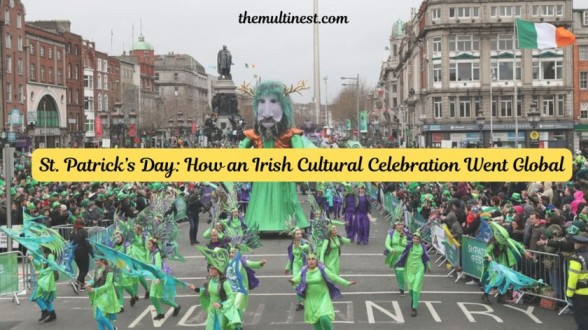
St. Patrick’s Day: It’s that time of the year again when the world goes green for St. Patrick’s Day. Buildings get lit up in green, people proudly wear shamrocks, and parades take over the streets.
The event, which originally was a religious feast day to celebrate the patron saint of Ireland, has now become a worldwide cultural festivity.
Currently, St. Patrick’s Day is not just an Irish holiday; it is a global festival of heritage, togetherness, and cheerfulness.
It makes perfect sense to inquire about the significance of this day, see how it is celebrated worldwide, and find out why brands, communities, and individuals keep on embracing it.
St. Patrick’s Day: How an Irish Cultural Celebration Went Global
What Is St. Patrick’s Day?
It is a day set aside on March 17 to commemorate the life and works of Saint Patrick, the patron saint of Ireland. Saint Patrick is credited with converting the pagans of Ireland to Christianity.
Initially, the day was purely a religious observance, but later it blossomed into a full-scale Irish cultural festival.
The shamrock, the wearing of green, Celtic tunes, and street dancing all represent the unique heritage of Ireland.
In the present day, St. Patrick’s Day signifies not only Irish pride but a worldwide passion for community and celebration.
Why Is St. Patrick’s Day Celebrated Worldwide?
Certainly, St. Patrick’s Day is celebrated worldwide, as the Irish diaspora extends to many parts of the world. Millions of Irish migrated to different parts of the world, such as the US, Canada, Australia, and the UK.
They brought their customs with them, and those customs were really embraced and admired.
Take, for instance, New York, Chicago, London, and Sydney, where each of these cities has a St. Patrick’s Day parade which attracts a huge number of tourists.
The famous green Chicago River, world landmark spots turned green, and Irish pubs filled with celebrations are all clear indications that the Irish culture is appreciated and celebrated everywhere.
In fact, St. Patrick’s Day celebrations have become a neat symbol of inclusiveness where absolutely anyone can partake in the festivities.
How Is St. Patrick’s Day Celebrated?
The way St. Patrick’s Day is marked may vary from one place to another, but the underlying spirit stays intact.
Some Global Traditions:
- The wearing of green clothes and shamrocks
- Big parades accompanied by Irish music and dance
- Irish traditional food such as soda bread and stew
- Folk, live bands and other types of cultural performances
- Community engagements and family occasion
In Ireland, the day is primarily seen as an occasion to harmonize one’s heritage with one’s sense of pride. Abroad, the festival is more like a cultural carnival which makes it one of the happiest days worldwide.
The Cultural Importance of St. Patrick’s Day
St. Patrick’s Day is more than just an opportunity for fun and merriment. It is a channel for:
- Saving one’s culture in the contemporary world
- Giving voice to the immigrant’s experience and mutual recognition
- Facilitating global harmony through age-old customs
For the Irish living abroad, this day is a means of keeping their traditions alive. For others, it serves as an avenue whereby one can learn, appreciate and celebrate diversity through culture.
St. Patrick’s Day and Modern Branding
St. Patrick’s Day has emerged as a great opportunity for brands and marketers to get in on the act. Businesses from hospitality, fashion, food, travel, and digital platforms focus on festivals to:
- Design thematic campaigns
- Increase engagement through green imagery and stories
- Offer limited-time deals and festive promotions
- Focus on culture-based content
When it is authentic, St. Patrick’s Day marketing feels very natural and joyful, and having a sense of community as the focal point rather than being forced.
Why St. Patrick’s Day Still Matters Today
In this ever-changing digital age, cultural festivals act as a break for most people to reconnect with each other and themselves.
St. Patrick’s Day is one such reminder that culture is not static but dynamic, getting stronger and more exciting as it is shared.
Regardless of whether one is Irish by birth or by spirit, it is an undeniable fact that on March 17, a special moment is created when everyone feels that they belong in something bigger and meaningful.
Conclusion
St. Patrick’s Day is more than just a number/figure on the calendar. It is a global festival celebrating Irish culture that unites people through its history, music, colours, and good vibes.
With celebrations happening worldwide, it is an excellent example of how traditions can transcend boundaries and bring communities closer.
So go ahead and wear your green on March 17, acknowledge and celebrate the culture, and raise your glass, not just to Ireland, but to the wonderful power that the shared heritage has around the world.
Read More:
World Day for Water (March 22): Why We Need to Value Every Drop More Than Ever
International Dance Day: A Day to Celebrate Movement, Expression, and the Language