
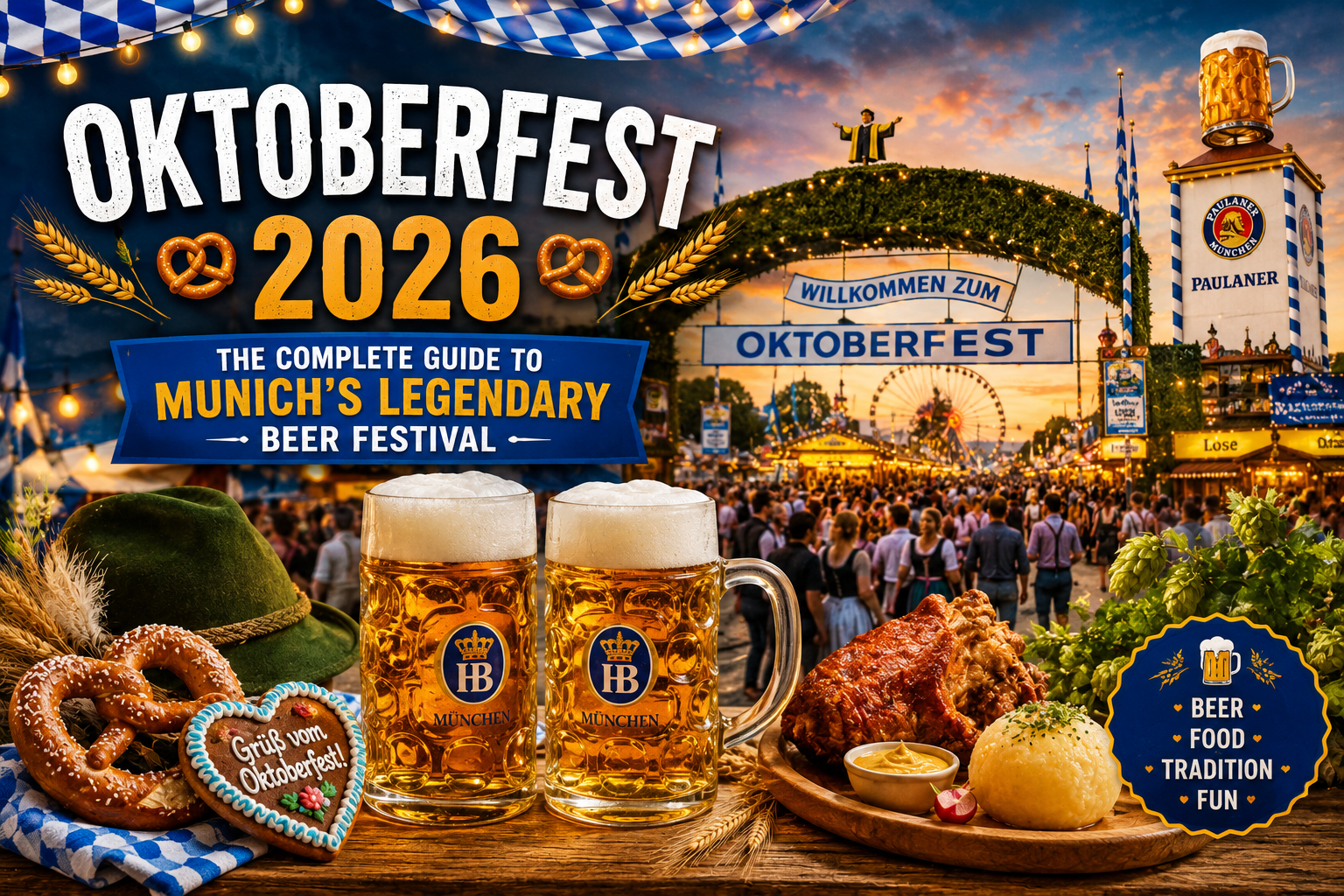
Six million people travel to one meadow in Munich every year. They come for beer, but they stay for something bigger. Oktoberfest 2026 runs from September 19 to October 4 at the Theresienwiese in Munich, Germany. This marks the 191st edition of the world’s largest folk festival. If you’re planning your first trip to the Wiesn, this guide covers everything: history, tents, tickets, outfits. And the practical details that make or break your Oktoberfest experience.
What Is Oktoberfest?
Oktoberfest is the world’s largest Volksfest, or folk festival. Munich hosts it every year on the Theresienwiese, a large fairground locals simply call “the Wiesn.” The festival blends beer tents, Bavarian food, live music, carnival rides, and traditional costume parades into sixteen days of celebration. More than six million visitors attend each year, spending roughly €1.5 billion across the festival’s run. That scale makes Oktoberfest 2026 not just a party, but a genuine economic engine for the city of Munich.
When Is Oktoberfest 2026?
Oktoberfest 2026 runs from Saturday, September 19, through Sunday, October 4. Despite its name, Oktoberfest mostly happens in September now. Organizers shifted the festival earlier decades ago to take advantage of Bavaria’s warmer, more reliable autumn weather. The festival always ends on the first Sunday in October, so the exact dates shift each year slightly. Daily hours vary by tent, but the grounds generally stay open from around 9:00 am to 10:30 pm.
The History Behind Oktoberfest
Oktoberfest began as a wedding celebration, not a beer festival. On October 12, 1810, Crown Prince Ludwig of Bavaria, who later became King Ludwig I, married Princess Therese of Saxony-Hildburghausen. Munich’s citizens were invited to celebrate on fields just outside the city gates. Those fields were later renamed Theresienwiese, or “Therese’s Meadow,” in the new princess’s honor. The name survives as the festival’s home to this day.
The celebrations culminated in a horse race on October 17, 1810. The race proved so popular that the city decided to repeat it the following year, and an annual tradition was born. For its first several decades, Oktoberfest functioned mainly as an agricultural fair. Complete with horse racing and cattle shows rather than beer tents.
The festival wasn’t always continuous. Bavaria’s involvement in the Napoleonic Wars forced organizers to cancel Oktoberfest in 1813. Carnival booths appeared in 1816, adding entertainment beyond the horse races. By 1819, Munich’s town leaders took over festival management and committed to holding it every year without exception. Beer stands didn’t evolve into the large tents we recognize today until 1896, when enterprising brewers realized bigger structures could serve far more visitors. A traditional costume parade joined the festival in 1835. Marking the royal couple’s 25th wedding anniversary, that parade tradition continues every Oktoberfest today.
Do You Need Tickets for Oktoberfest?
Entry to Oktoberfest is completely free. You don’t need a ticket to walk onto the festival grounds, and you don’t need a ticket to enter most beer tents either. This surprises many first-time visitors who expect a festival this famous to require paid admission.
That said, getting a seat inside a tent is a different story. Tents only serve beer to seated guests, and during evenings and weekends, popular tents fill up fast. Without a reservation, you may wait in line for hours, or get turned away entirely once a tent reaches capacity. Reservations aren’t compulsory, but organizers and seasoned visitors strongly recommend booking a table in advance, especially if you’re traveling as a group or planning to visit during peak hours. Tables get reserved far ahead of the festival, and once booked, the name on a reservation typically cannot be changed.
The Beer Tents: Where Oktoberfest Really Happens
Fourteen large tents anchor the Wiesn each year, run by Munich’s major breweries. Each tent gets fully constructed and then dismantled annually, since nothing on the grounds is permanent. Stepping into one of these tents for the first time is a genuine sensory experience. Picture a canvas structure the size of an aircraft hangar, filled with 10,000 people singing along to an oompah band, all raising liter-sized beer steins in unison. Photos and videos consistently fail to capture what that atmosphere actually feels like.
Munich law limits Oktoberfest beer to six specific breweries: Augustiner, Hacker-Pschorr, Hofbräu, Löwenbräu, Paulaner, and Spaten. Only beer brewed within Munich’s city limits by these breweries can be served at Oktoberfest, a rule that protects the festival’s authenticity and keeps its beer culture rooted specifically in the city’s brewing tradition.
What to Wear to Oktoberfest
Traditional Bavarian clothing, known as Tracht, dominates the Wiesn. Roughly 80% of attendees wear it, and this isn’t costume territory. Tracht is genuine regional clothing still worn at Bavarian weddings, christenings, and local festivals throughout the year. Locals can spot the difference between an authentic Dirndl and a cheap costume-shop version instantly.
Men typically wear Lederhosen, knee-length leather shorts, paired with a checkered shirt in red, blue, or green, or a plain white shirt with traditional buttons. Women typically wear a Dirndl, a fitted dress with an apron, often paired with a blouse underneath. You don’t have to wear Tracht to attend Oktoberfest, but the experience genuinely shifts when you do. Tent staff tend to treat Tracht-wearing guests more warmly, locals strike up conversation more readily, and your photos will hold up far better years down the line.
Beyond clothing, pack practically. Munich tightened security after 2016, and every entrance now checks bags. Bags must stay under 3 liters in size, roughly 20 by 15 by 10 centimeters. Backpacks and large purses won’t get through security, though crossbody bags usually pass. Bring cash, since many smaller stands inside the grounds don’t accept cards. A light jacket or wrap helps for cooler evenings, and comfortable shoes matter more than you’d expect, since spilled beer on the tent floor is simply part of the experience.
How Much Does Oktoberfest Actually Cost?
Beer and food inside the tents add up quickly, but the festival’s biggest expense is almost always accommodation. Munich hotels sell out six to twelve months in advance for Oktoberfest dates. Rooms that remain available often double or triple their normal rates, with mid-range central hotels running €250 to €500 per night during the festival window. Apartment rentals ten to fifteen minutes from the Theresienwiese tend to offer better value, particularly if booked early. Munich’s public transit stays cheap by comparison, at roughly €8.80 per day, making it easy to stay slightly outside the city center and still reach the festival grounds quickly.
Getting There and Getting Around
The Theresienwiese sits close to central Munich and connects easily by U-Bahn and tram. Several stations serve the grounds directly, and Munich’s public transit system runs frequently throughout the festival, including extended hours on weekends to handle the crowds heading home late at night. Flying into Munich Airport works well for international visitors, with train and bus connections running straight into the city center.
Oktoberfest Highlights Beyond the Beer Tents
Oktoberfest offers plenty beyond drinking, even if the tents get most of the attention. The Grand Entry of the Oktoberfest Landlords and Breweries kicks off the festival on opening Saturday, featuring a parade of horse-drawn carriages, decorated with flowers and loaded with beer barrels, moving through Munich’s streets before reaching the Theresienwiese. The ceremonial opening of the first keg follows shortly after, when Munich’s mayor taps the barrel and declares the festival officially open.
The traditional costume parade takes place on the first Sunday of the festival, featuring thousands of participants in historical and regional dress from across Bavaria and beyond. Beyond the parades, the festival grounds include a full traveling carnival, with roller coasters, Ferris wheels, and classic fairground games sitting right alongside the beer tents. Families with children often visit during daytime hours, when the atmosphere stays calmer and several tents offer dedicated family sections away from the evening crowds.
Tips for a Smooth Oktoberfest Experience
Arrive early if you don’t have a tent reservation. Popular tents start forming lines from lunchtime on weekdays, and lines begin at early morning on weekends. Pace yourself with the beer. Oktoberfest steins hold a full liter, considerably more than a standard pint, and the festival’s combination of alcohol, crowds, and long days catches many first-time visitors off guard. Eat substantially before and during your visit. Bavarian festival food, from pretzels to roast chicken to sausages, isn’t just tradition, it genuinely helps you pace your drinking through a long day at the tents.
Solo travelers, including solo women, generally report feeling comfortable at Oktoberfest, and the festival maintains a dedicated Security Point inside the Servicezentrum for anyone who needs support. Munich’s overall reputation for safety extends to the festival grounds, though the sheer size of the crowds still calls for the same common-sense awareness you’d bring to any major event.
Final Thoughts on Oktoberfest 2026
Oktoberfest 2026 runs September 19 through October 4 on Munich’s Theresienwiese, marking 191 years of a tradition that began with a royal wedding in 1810. Whether you come for the beer, the music, the food, or simply the spectacle of six million people celebrating together, Oktoberfest delivers an experience genuinely unlike anything else in the world. Book your accommodation early, reserve a tent table if you can, and pack a Dirndl or Lederhosen if you want the full experience. The rest takes care of itself once you’re standing inside a tent, stein in hand, singing along with ten thousand strangers.
Frequently Asked Questions About Oktoberfest
When is Oktoberfest 2026? Oktoberfest 2026 runs from Saturday, September 19, through Sunday, October 4, 2026, at the Theresienwiese in Munich, Germany.
Do I need a ticket to attend Oktoberfest? No. Entry to the Oktoberfest grounds and most beer tents is completely free. You only need a reservation if you want a guaranteed seat inside a tent, especially during evenings and weekends.
Why is Oktoberfest held in September instead of October? Organizers moved most of the festival into September decades ago to take advantage of Bavaria’s warmer, more predictable autumn weather. The festival still always ends on the first Sunday in October, which keeps the name Oktoberfest technically accurate.
How did Oktoberfest start?
Oktoberfest began as a public celebration of Crown Prince Ludwig of Bavaria’s wedding to Princess Therese of Saxony-Hildburghausen on October 12, 1810. A horse race held five days later proved so popular that Munich repeated the celebration the following year, and the annual tradition was born.
What beer is served at Oktoberfest?
Only beer brewed within Munich’s city limits by six specific breweries counts as official Oktoberfest beer: Augustiner, Hacker-Pschorr, Hofbräu, Löwenbräu, Paulaner, and Spaten. This rule keeps the festival’s beer culture rooted specifically in Munich’s own brewing tradition.
Do I have to wear a Dirndl or Lederhosen to Oktoberfest?
No, but most attendees do. Roughly 80% of visitors wear traditional Bavarian Tracht, and doing so genuinely changes the experience, since tent staff and locals tend to respond more warmly to guests in traditional dress.
How much does a trip to Oktoberfest cost?
Beer and food add up, but accommodation is usually the biggest expense. Mid-range central Munich hotels often run €250 to €500 per night during the festival, since rooms sell out six to twelve months in advance. Public transit stays affordable, at roughly €8.80 per day.
Can I bring a bag into Oktoberfest?
Only small bags. Security requires bags to stay under 3 litres, roughly 20 by 15 by 10 centimetres. Backpacks and large purses aren’t permitted, though small crossbody bags typically pass through security checks.
Is Oktoberfest safe for solo travelers?
Yes. Solo travelers, including solo women, generally report feeling comfortable at Oktoberfest. The festival maintains a dedicated Security Point inside the Servicezentrum, and Munich’s overall reputation for safety extends to the festival grounds.
How many people attend Oktoberfest each year?
More than six million visitors attend Oktoberfest annually, spending an estimated €1.5 billion across the festival’s roughly sixteen-day run, making it the largest public festival in the world.

Monika Raisinghani is a content writer with over 10 years of experience writing for different industries. She enjoys turning ideas into simple, useful, and engaging content that people actually want to read. Whether it’s health, lifestyle, business, or technology, she focuses on providing accurate information in a clear and relatable way. She believes good content should be easy to understand, helpful, and written with the reader in mind.