
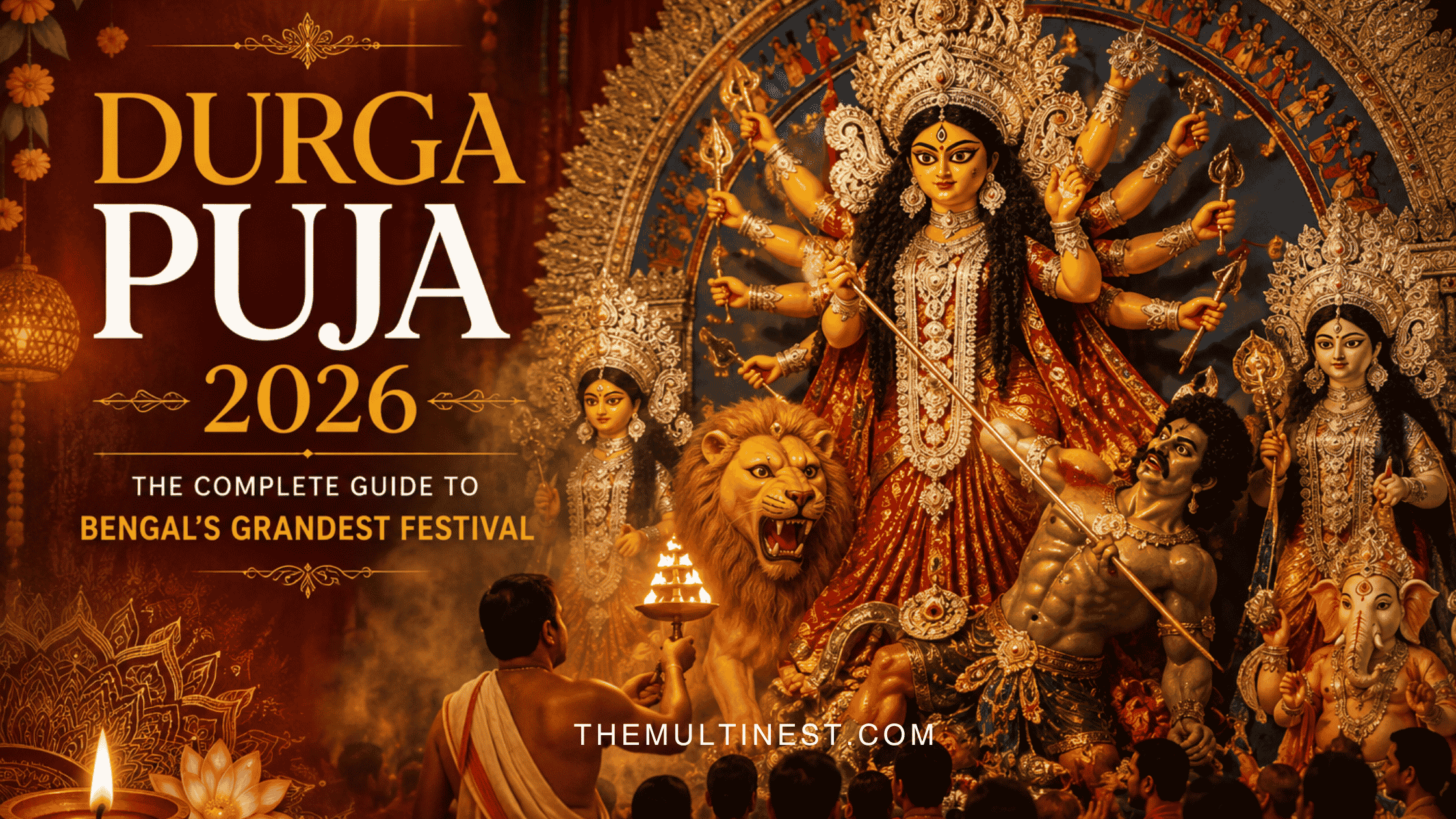
One festival can feel like Christmas, Carnival, and a family reunion, all happening at once. Durga Puja does exactly that across West Bengal, Odisha, Bangladesh, and Nepal every autumn. Durga Puja 2026 runs from October 17 to October 21, and for five days. Entire cities transform into open-air galleries of devotion, art, and celebration. This guide covers the dates, the history, the rituals, and everything You need to understand why millions of people wait all year for these five days.
What Is Durga Puja?
Durga Puja celebrates Goddess Durga’s victory over the buffalo demon Mahishasura. The story symbolizes the triumph of good over evil, but the festival itself means something deeper to Bengali communities. Durga isn’t a distant deity here. She’s a daughter coming home. According to tradition, Maa Durga returns once a year to her parents’ house on earth, bringing her four children with her. Lakshmi, Saraswati, Kartik, and Ganesha. For five days, she stays. On the final day, she leaves again, returning to Mount Kailash and to Shiva.
That simple emotional core, a daughter’s annual homecoming, has grown into one of the most elaborate festivals in the world. Millions of devotees gather in beautifully decorated pandals, offer prayers, watch cultural performances. And celebrate the divine feminine across five packed days.
When Is Durga Puja 2026?
Durga Puja 2026 runs from October 17 to October 21. The festival technically begins earlier, on Mahalaya, when Devi Paksha commences. And the goddess is symbolically invoked to descend to earth. But the five major days, from Shashthi through Vijayadashami, form the true heart of the celebration. Maha Shashthi falls on October 17, and the festival closes with Vijayadashami on October 21.
The History Behind Durga Puja
Durga Puja’s earliest formal celebrations trace back to wealthy zamindar households in Bengal during the 16th and 17th centuries. The Sabarna Roy Choudhury family of Barisha, Kolkata, claims to have organized Durga Puja since 1610. Making theirs one of the oldest recorded community celebrations. Other aristocratic families, including the Tagores of Jorasanko and the Mittras of Shyambazar. Held elaborate pujas that served two purposes at once: genuine religious observance and a public display of social status. The public could watch, but for centuries, the puja itself stayed private, funded and organized entirely by wealthy households.
That changed in 1910. A group of twelve friends in Guptipara, Hooghly, pooled their money to organize. A community puja they called “Barowari,” combining the Bengali words for twelve and friends. This shift toward community-funded, community-organized celebration eventually became the dominant model, known today as “Sarbojanin,” meaning “for all.”
Durga Puja’s role expanded further in the early 20th century. During India’s freedom struggle, nationalist leaders invoked Goddess Durga as a symbol of the nation itself. Personified as Bharat Mata, or Mother India. The Swadeshi movement embraced the festival as a vehicle for resistance against British colonial rule. Adding a layer of political meaning to what had started as a religious and social occasion. That history still echoes through the festival’s identity today. A celebration that has always adapted to reflect Bengal’s social and political moment.
In 2021, UNESCO recognized Kolkata’s Durga Puja as an Intangible Cultural Heritage of Humanity. Formally acknowledging what Bengalis had always known: this festival represents something the world needs to preserve.
The 5 Days of Puja
Mahalaya kicks off the festival, though it technically falls before the main five days. Families wake before dawn to listen to Mahishasur Mardini, a devotional radio broadcast that has aired annually for decades and remains a cherished ritual across Bengali households. On this day, artisans complete the goddess’s idol through Chokkhudaan, painting the eyes as the very last step, bringing the deity to life just as the sun rises. Mahalaya also involves Tarpan, a ritual where people offer food and water to their departed ancestors.
Shashthi, falling on October 17 in 2026, marks the official start of the festival. Devotees ceremonially awaken Goddess Durga and formally invite her into the beautifully decorated pandals that will host her for the next five days.
Saptami and Ashtami bring the festival’s most elaborate rituals. Saptami includes the Prana Pratishtha ceremony, which spiritually installs life into the idol. Ashtami features Pushpanjali, the collective offering of flowers accompanied by chanted mantras, one of the festival’s most visually striking communal moments. Sandhi Puja, performed at the precise junction between Ashtami and Navami, holds special significance as the moment Durga is believed to have slain Mahishasura.
Navami continues the intensity of worship, often considered the most spiritually charged day of the festival, with elaborate Vedic rituals continuing throughout.
Vijayadashami, falling on October 21 in 2026, closes the festival. This is the day of Sindoor Khela, when married women smear each other with vermilion powder in a joyous, deeply symbolic ritual celebrating marital blessings and community bonds. The day ends with Visarjan, the immersion of the goddess’s idol into a river or body of water. Watching the idol disappear beneath the water produces an emotion that isn’t quite grief, but isn’t entirely separate from it either. It’s the feeling of watching a daughter leave home again, knowing she’ll return next year.
Where Durga Puja Is Celebrated
West Bengal remains the undisputed heart of Durga Puja, where the festival transforms into a state-wide celebration of art, community, and devotion. Kolkata alone hosts thousands of pandals each year, ranging from modest neighborhood setups to massive, artistically ambitious installations that draw visitors purely to see the pandal design itself.
Beyond West Bengal, Durga Puja holds official public holiday status in Odisha, Tripura, Bihar, and Assam. Bangladesh and Nepal celebrate the festival as a public holiday too, reflecting deep historical and cultural ties across the region. Pakistan recognizes it as an optional holiday. Nepal’s own Dashain festival shares the same Puranic roots as Durga Puja, and the parallel traditions highlight just how far back this shared mythology stretches across South Asia.
The celebration has also traveled with the Bengali diaspora. Communities in Germany, Hong Kong, the United States, Switzerland, Sweden, and the Netherlands organize their own Durga Puja celebrations, proof that the festival’s emotional pull travels well beyond its geographic origins.
The Pandals: Bengal’s Living Art Galleries
Pandals are temporary structures built specifically to house the goddess’s idol during the festival, and in West Bengal, they’ve evolved into genuine works of art. Each pandal features a uniquely sculpted clay idol of Durga, flanked by her children Lakshmi, Saraswati, Ganesha, and Kartikeya. Neighborhood committees compete each year to create the most striking and creative pandal designs, drawing on everything from traditional temple architecture to abstract contemporary art, sometimes built around a specific social theme or message.
Visiting multiple pandals, known as “pandal hopping,” is one of the festival’s central social activities. Streets fill with illuminated decorations, cultural programs run late into the night, and families walk from neighborhood to neighborhood taking in the artistry on display.
Food and Festivities
Durga Puja isn’t complete without its food. Devotees share bhog, the communal offering that typically includes khichuri, labra, and chutney, distributed to worshippers as a blessed meal. Beyond the religious offerings, festival streets fill with Bengali delicacies: luchi, mishti doi, and rosogolla among the most beloved. Food stalls spring up around major pandals, turning the festival into as much a culinary event as a religious one.
Practical Tips for Experiencing Durga Puja
Comfortable shoes matter more than almost anything else you pack. Durga Puja involves an enormous amount of walking, especially if you’re pandal hopping across a city like Kolkata. Breathable clothing helps too, since October in Bengal still carries real warmth and humidity.
Pace yourself. A common mistake among first-time visitors involves trying to see too many pandals in too little time, leading to exhaustion well before the festival’s most important rituals even begin. Focus on a handful of pandals that genuinely interest you rather than racing to check off a long list. Carry water, a power bank for your phone, and wet wipes, since festival crowds make quick breaks harder to find than you’d expect.
Engage directly with the rituals rather than just observing from a distance. Attend Pushpanjali on Ashtami if you can, and witness Sindoor Khela on Vijayadashami. These moments offer a far deeper connection to the festival than pandal-hopping alone ever could.
Why Durga Puja Matters
Durga Puja is, at its core, a festival about homecoming, resilience, and community. It has survived colonial rule, adapted to serve as a symbol of national resistance, evolved from private aristocratic ritual into genuinely public celebration, and earned recognition as a piece of humanity’s cultural heritage. Few festivals anywhere in the world manage to combine religious devotion, artistic ambition, and community bonding as seamlessly as Durga Puja does across these five days every October.
FAQS
When is Durga Puja 2026?
Durga Puja 2026 runs from October 17 to October 21, 2026, with Maha Shashthi on October 17 and Vijayadashami on October 21.
What does Durga Puja celebrate?
Durga Puja celebrates Goddess Durga’s victory over the demon Mahishasura, symbolizing the triumph of good over evil. Culturally, it also celebrates the goddess’s annual homecoming to earth alongside her four children.
Where is Durga Puja celebrated?
Durga Puja holds public holiday status in West Bengal, Odisha, Tripura, Bihar, and Assam, as well as in Bangladesh and Nepal. Pakistan recognizes it as an optional holiday. Bengali communities worldwide, including in Germany, the United States, and Switzerland, also organize their own celebrations.
What are the five main days of Durga Puja?
The five main days are Shashthi, Saptami, Ashtami, Navami, and Vijayadashami. Each day carries specific rituals, from the ceremonial awakening of the goddess on Shashthi to the emotional idol immersion, or Visarjan, on Vijayadashami.
What is Sindoor Khela?
Sindoor Khela is a ritual performed on Vijayadashami, where married women smear each other with vermilion powder as a joyous celebration of marital blessings and community bonds, marking one of the festival’s most visually striking moments.
What is a pandal?
A pandal is a temporary structure built to house the goddess’s idol during Durga Puja. In West Bengal, pandals have evolved into elaborate works of art, with neighborhood committees competing each year to create the most creative and visually striking designs.
Is Durga Puja recognized internationally?
Yes. UNESCO recognized Kolkata’s Durga Puja as an Intangible Cultural Heritage of Humanity in 2021, acknowledging its global cultural significance.
What food is associated with Durga Puja?
Bhog, typically including khichuri, labra, and chutney, is offered to worshippers as a blessed communal meal. Festival streets also fill with Bengali delicacies like luchi, mishti doi, and rosogolla.
How did Durga Puja become a public celebration instead of a private one?
For centuries, wealthy zamindar families privately funded and organized Durga Puja. That changed in 1910, when twelve friends in Guptipara, Hooghly, pooled money to organize a community-funded “Barowari” puja, laying the groundwork for the community-organized “Sarbojanin” model that dominates the festival today.
Does Nepal celebrate a similar festival?
Yes. Nepal’s Dashain festival shares the same Puranic roots as Durga Puja and follows a similar timeline, reflecting the deep, shared mythology that connects Durga worship across South Asia.
Festival dates follow the Hindu lunisolar calendar and can shift slightly depending on regional Panchang calculations. Confirm exact local dates and puja timings closer to the festival.
Monika Raisinghani is a content writer with over 10 years of experience writing for different industries. She enjoys turning ideas into simple, useful, and engaging content that people actually want to read. Whether it’s health, lifestyle, business, or technology, she focuses on providing accurate information in a clear and relatable way. She believes good content should be easy to understand, helpful, and written with the reader in mind.